
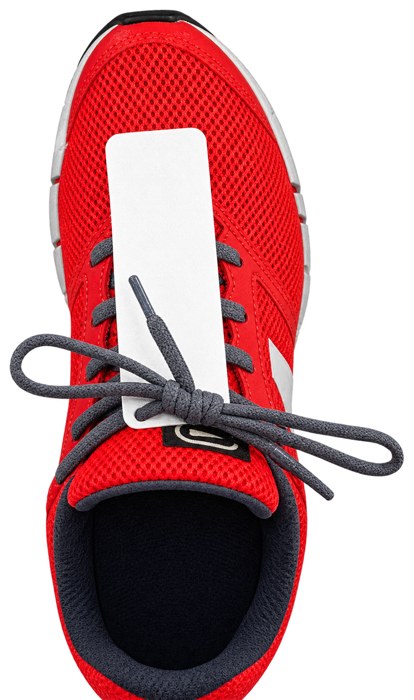
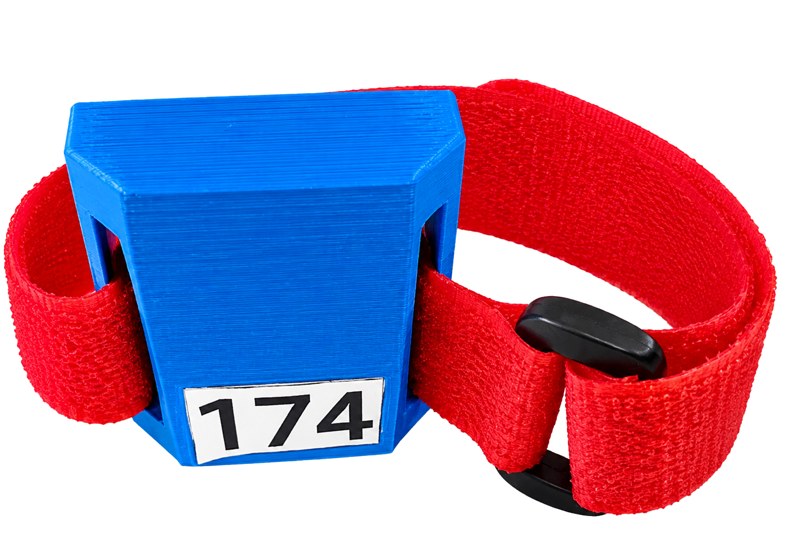
The chip is what each participant wears and what the reader detects when they cross the finish line. Choosing the right chip determines how much each event costs, how many people you can read at once and whether the system works in water or at 200 km/h. This guide helps you get it right.
1 · Passive chip or active chip
It's the first decision, because it determines the reader you need.
- No battery: it's powered by the signal from the antennas.
- Very cheap: from 0,10 € per chip.
- Mass reading: with anti-collision, more than 1,000 chips are detected at the same instant.
- Overhead or ground antennas on the finish line.
Readers: SI91, ATL98 and the handheld readers BLUE 1 and the CRONOPISTOLA.
- Runs on a CR2032 battery, easy to replace, with a low-battery warning.
- Reusable and water-resistant.
- Reads at 200 km/h: the chip sleeps and only transmits when crossing the finish.
- No obstacles: the antenna is a cable across the finish line.
Reader: ACTSLEEP2.45, for events of up to 300 participants.
2 · Which chip to use for each sport
3 · Disposable or reusable
Within each technology you can choose the format depending on how you organise the event:
- Disposable (Dorsalchip, Pegachip): ultralight and cheap. The participant keeps it and you don't have to collect them at the finish. The most convenient option for popular races.
- Reusable (Chippie, Trichip, Tarjetachip): they're collected at the finish and can be used for many events. Worth it if you often time the same group, as in leagues or race series.
- Active chips: always reusable. You only need to change the battery when the chip gives a low-battery warning.
- Trackchip: it's not a finish chip but a tracking one, with GPS position, continuous location and an SOS button.
4 · Where to buy the chips
With Cronomach you don't have to buy your chips from us. We give you the specifications of the chips to use for each discipline so you can buy them from whichever supplier you prefer.
Then you encode them yourself: the SI91 includes the chip encoding program, and with the USB Writer you can encode, check and reprogram chips one by one. What's more, the system recognises the chips programmed for the current competition and discards those from past events, so there's no confusion if a runner turns up with a chip from another race.
5 · Summary
| Sport | Chip | Where it goes |
|---|---|---|
| Running, trail | UHF passive | On the bib |
| Amateur cycling | UHF passive | Bib or number plate |
| Licensed cycling, MTB | Active or passive | Bike number plate |
| Triathlon, duathlon | Active or passive | Ankle, with neoprene strap |
| Open water swimming | Active | Ankle or wrist |
| Motorsport | Active transponder | On the vehicle |
| Time trial, downhill | No chip (PHOTOCELL) | — |
Questions about your event? Check the frequently asked questions or tell us about your event and we'll tell you which chip and which reader suit it best.
Which chip does your event need?
Tell us the sport and the number of participants and we'll recommend the complete system.